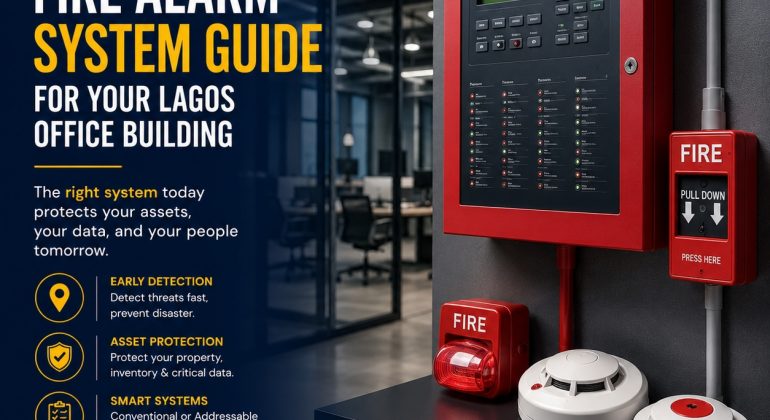

It is 2:00 AM on a Saturday, and your building’s fire alarm system is the only thing standing between safety and total disaster. At this hour, your commercial property is completely empty. Consequently, it houses millions of Naira in IT infrastructure, unrecoverable data, and valuable warehouse stock with no one on site. Suddenly, a tiny electrical fault sparks in a locked utility closet.
If your setup is just a “tick-the-box” tool bought to pass an inspection, your entire investment is in severe danger. Therefore, true asset protection isn’t about framing a compliance certificate on the wall. Instead, it is about what happens in those first two critical minutes of a quiet emergency.
Ultimately, the choice between a Conventional and an Addressable setup changes everything. Your system will either pinpoint the threat down to the exact room, or leave your team blindly guessing which floor is in trouble.
Managing a commercial facility or developing a property in Lagos is a high-stakes job. On any given day, you split your mind between fluctuating project costs, vendor SLAs, and avoiding operational downtime. Because daily management demands so much energy, fire safety often gets pushed to the back burner. As a result, many treat it as a boring compliance chore just to satisfy inspectors.
But look at the real psychology behind asset protection. You did not pour millions in capital and months of construction into a building to leave its survival to chance. For this reason, true peace of mind means knowing your investments, your inventory, and your people are entirely secure during a sudden power surge.
When designing your building’s safety net, you face a critical technical decision. Specifically, you must choose between a Conventional or an Addressable fire network. Making the wrong choice leads to massive installation overruns, frustrating false alarms, or critical response delays.
Let’s strip away the engineering jargon. Here is how these two systems work in the real world so you can make the right decision.
1. Conventional Infrastructure: The Broad Safety Net
Think of a conventional system as a broad-brush approach to security. It divides your building into general physical “zones” instead of pointing to individual rooms.
Engineers wire all smoke detectors, break-glass call points, and sounders on a floor into a single electrical circuit. We call this circuit a zone. For example, if smoke triggers a sensor in a back room on the second floor, the detector goes off. The main control panel then flashes a general alert: “Fire: Zone 2 (2nd Floor).”
From a practical perspective, conventional setups offer a lower upfront hardware cost. Furthermore, they are straightforward to set up. If you manage a small, single-floor facility, a basic retail shop, or an open warehouse layout, this basic fire alarm system provides perfectly adequate protection without breaking your budget.
However, this system does not give you an exact location. Your second floor might contain twenty separate enclosed offices, meeting rooms, or storage units. If so, your emergency response team will lose precious minutes playing detective. They must manually check every single room to find the source of the danger while the hazard spreads.
2. Designing an Addressable Fire Alarm System for Lagos
An addressable network is the modern standard for complex, high-value corporate, residential, and commercial environments. Instead of grouping devices blindly by zones, every single component on this advanced fire alarm system has its own unique digital identity or address.
With this setup, a continuous wire loop links all detectors, heat sensors, and isolation modules. Meanwhile, the intelligent control panel constantly communicates with each individual device. It monitors their exact status around the clock. If a sensor detects a threat, the panel removes all guesswork instantly. For instance, the display reads something highly specific: “Fire: 3rd Floor, Server Room, Smoke Detector No. 12.”
Eliminating False Alarms and Delays
The real business value here is unmatched speed when seconds count. In multi-story commercial towers, shopping plazas, or complex mixed-use facilities, saving two minutes of searching prevents catastrophic, business-ending loss.
Furthermore, these intelligent systems monitor individual devices actively. The panel tells you exactly when a specific sensor gathers dust or begins to fail. Consequently, this feature completely eliminates the frustrating false alarms that disrupt tenants, panic customers, and cause staff to ignore sirens.
Investment Versus Absolute Control
The initial investment for intelligent control panels and smart sensors is higher upfront. Additionally, the network requires specialized engineering expertise to program and commission correctly. Despite this, it represents the gold standard in modern asset protection.
3. Choosing the Right Engineering Partner for Your Property
Choosing the right system comes down to a balance of building scale, asset value, and risk tolerance. If your property is a straightforward, low-occupancy space where an issue is instantly visible to anyone, a conventional setup is a reliable, budget-friendly option.
However, your situation changes if your building spans multiple floors, houses a dedicated data room, manages sensitive inventory, or accommodates a high volume of clients. In these cases, an addressable fire alarm system is a non-negotiable investment. Therefore, the precision, advanced diagnostics, and rapid response capability provide essential safety for your corporate assets and your building’s legacy.
Do not wait for an infrastructure failure or a close call to evaluate your building’s safety design. Protect your property, secure your corporate assets, and ensure full compliance before your project hits its next phase.
You can only have the best systems supplied and installed to you by contacting the engineering specialists at Chrelect MEP Limited today for a comprehensive fire alarm system audit of your Lagos commercial property.